

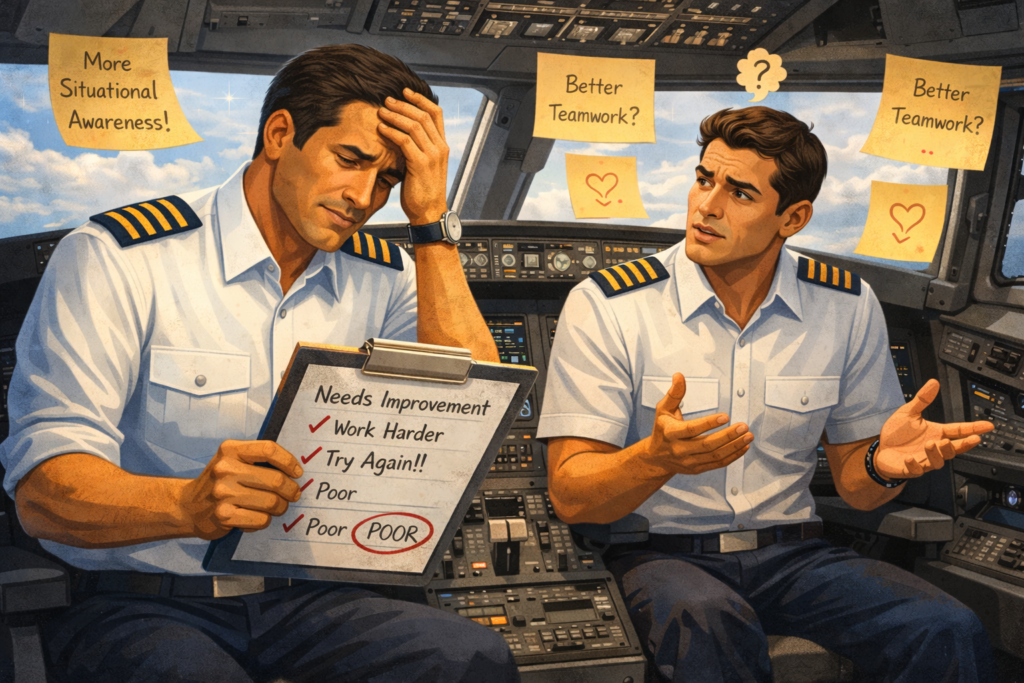
Why Some Pilots Struggle in EBT Programs — And It’s Not Their Fault
Evidence-Based Training (EBT) has been one of the most important advances in airline training over the past decade.
By focusing on real-world operational data, EBT helps training departments identify the events and situations that pilots must be able to manage effectively.
It has improved the relevance of simulator training enormously.
But during discussions with instructors and training captains from different airlines, a common observation often emerges.
Some pilots struggle more than others when these scenarios become complex.
The natural assumption can be that these pilots simply lack the required competencies.
But that explanation may not always be the most accurate one.
When Performance Gaps Appear
In a typical EBT scenario, crews may be exposed to events such as:
- unreliable airspeed
- automation surprises
- system degradations
- high workload abnormal situations
These events are often embedded within a broader operational scenario designed to test multiple competencies at the same time.
For example:
- situational awareness
- workload management
- leadership and teamwork
- decision making
- communication
When the scenario becomes demanding, some crews integrate these elements effectively.
Others struggle.
The immediate interpretation can be that the struggling pilot lacks the competency.
But another explanation is often possible.
The Integration Problem
Managing complex events in the simulator requires the integration of several layers of understanding:
- Technical knowledge of the aircraft and systems
- Understanding of procedures and why they exist
- Competency behaviours such as communication, leadership, and workload management
- Decision making under time pressure
If one of these layers is weak, the entire performance can start to unravel.
For example, if a pilot does not fully understand the underlying logic of a system failure, situational awareness can degrade quickly.
As workload increases, decision making becomes more difficult.
Communication may become less structured.
What looks like a competency problem may actually have started as a knowledge or systems understanding gap.
The Simulator Discovery Effect
Another pattern that instructors sometimes observe is that pilots encounter certain operational events for the first time in the simulator.
The simulator then becomes a place where pilots are expected to:
- understand the problem
- recall the correct procedures
- apply multiple competencies
- manage the aircraft
- and coordinate with the crew
—all at the same time.
When learning occurs under these conditions, performance can appear inconsistent.
Not because the pilot lacks capability, but because several different learning tasks are happening simultaneously.
When Preparation Changes Everything
When pilots enter simulator sessions with a clear understanding of:
- the systems involved
- the operational logic behind the procedures
- the competencies required to manage the event
something interesting happens.
The simulator stops being a place where pilots discover how to manage the situation.
Instead, it becomes a place where they integrate what they already understand.
Performance becomes more structured.
Crew coordination improves.
Decision making becomes more deliberate.
And instructors can focus on refining behaviours rather than explaining the fundamentals during the debrief.
Shifting the Training Balance
EBT has helped the industry identify which operational events matter most.
The next challenge may be ensuring that pilots are fully prepared to manage those events before they enter the simulator.
That preparation does not replace simulator training.
It strengthens it.
By building the conceptual foundation first, simulator sessions can focus on what they do best:
Integrating competencies in realistic operational scenarios.
A Question for Instructors and Training Managers
When pilots struggle in complex simulator scenarios, where do you most often see the root cause?
Is it primarily:
- competency behaviours
- systems understanding
- procedural knowledge
- or the integration of all three?
And how do your training programs prepare pilots to bring those elements together before the simulator session begins?
I would be very interested to hear perspectives from instructors and training departments across the industry.