

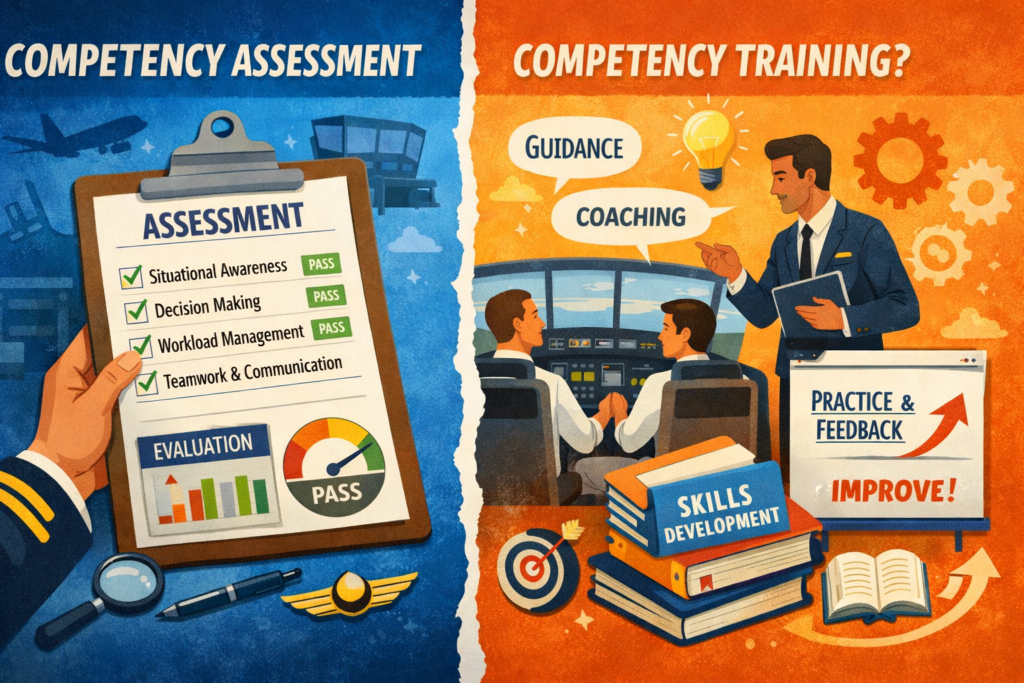
Airlines Assess Competencies Well. But Are We Actually Training Them?
Over the past few years working with airlines and training departments in different parts of the world, one observation has become increasingly clear to me.
Most airlines assess pilot competencies extremely well.
But far fewer airlines actually train them.
This is not a criticism of airline training departments. In fact, many of them are doing excellent work implementing modern frameworks such as Evidence Based Training (EBT) and Competency Based Training and Assessment (CBTA).
The issue is more subtle.
There is a quiet assumption embedded in many training systems that pilots already possess the underlying competencies that are being assessed.
And in many cases, that assumption turns out not to be true.
The Competency Assessment Revolution
Over the last decade the industry has done an outstanding job developing competency frameworks.
Most airlines now assess pilots across areas such as:
- Communication
- Leadership and teamwork
- Workload management
- Problem solving and decision making
- Situational awareness
- Threat and error management
These competencies are evaluated during simulator sessions and line checks using structured grading systems and behavioural markers.
This represents a major improvement over the older model of simply assessing aircraft handling and procedural knowledge.
But an important question often remains unanswered.
Where, exactly, are these competencies being taught?
The Assumption Problem
In many programs, pilots enter simulator scenarios where these competencies are expected to appear naturally.
If they demonstrate them effectively, they pass.
If they struggle to demonstrate them, the result may be recorded as a performance gap in the competency assessment.
But the question that is rarely asked is a simple one:
Were these competencies ever explicitly taught in the first place?
Many pilots develop these skills over time through experience, mentorship, and exposure to good role models.
But that process is not always consistent.
Two pilots with identical flying hours can have very different levels of capability in areas such as leadership, communication, and decision making.
A Quiet Frustration in Training
This can create a subtle frustration on both sides of the training process.
Pilots sometimes feel they are being assessed against behavioural standards that were never clearly explained or taught.
Instructors often recognise the issue, but may not always have structured tools available to teach the competencies directly.
As a result, simulator sessions sometimes become a mixture of:
- technical training
- scenario management
- competency observation
- and performance grading
all happening simultaneously.
When things go well, the system works.
When they do not, the root cause is not always obvious.
Competencies Are Not Personality Traits
One of the misconceptions that sometimes exists is that competencies such as leadership, communication, and decision making are largely personality-driven.
But in reality, these behaviours can be trained and developed.
Just like aircraft handling or instrument scanning, they can be broken down into:
- clear concepts
- repeatable techniques
- structured practice
When this happens, pilots gain a much deeper understanding of how to apply these competencies in both normal and abnormal situations.
And when they return to the simulator, the assessment process becomes far more meaningful.
The Next Evolution of Training
Competency assessment has been a major step forward for the industry.
The next evolution may be ensuring that competency training develops alongside it.
Not replacing simulator training, but complementing it by building the foundations that pilots need before they arrive in the sim.
This approach can make simulator training more effective, more focused, and often less stressful for everyone involved.
I’d Be Interested in Your Experience
For training captains, TRI/TREs, instructors, and training managers:
- Do your programs explicitly teach pilot competencies, or are they primarily assessed during simulator scenarios?
- What methods have you seen work well in developing these skills?
- Where do you see the biggest gaps in current training systems?
I would be very interested to hear different perspectives from across the industry.