

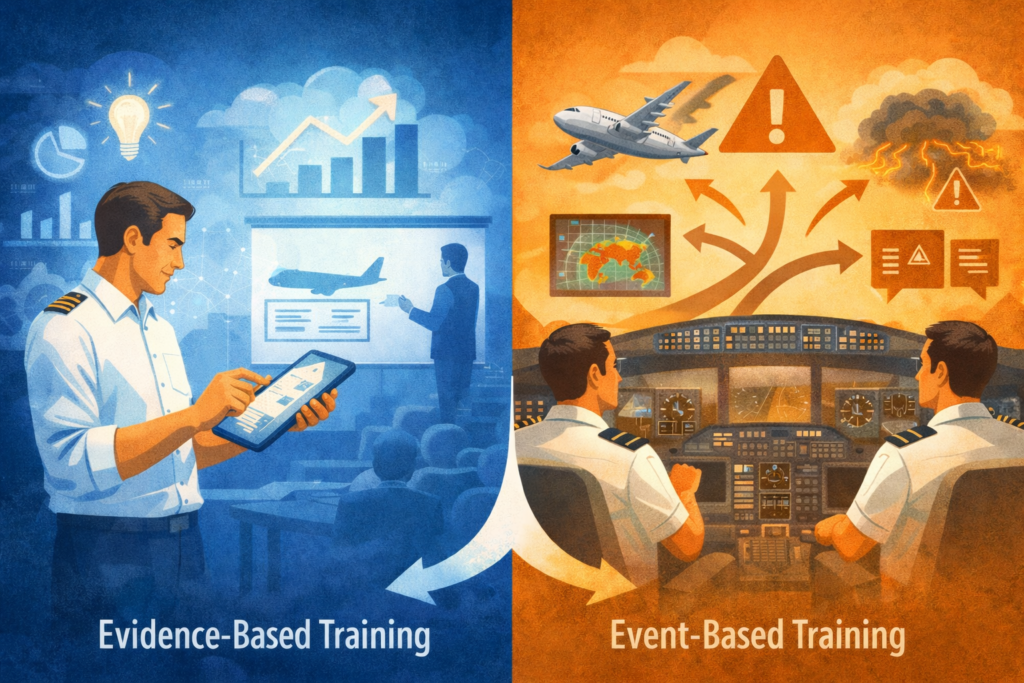
Evidence-Based Training vs Event-Based Training
Are We Sometimes Missing the Point?
Evidence-Based Training (EBT) has been one of the most important developments in airline training over the past decade.
By analysing real operational data, EBT identifies the types of events pilots must be able to manage effectively. These events then form the basis of simulator scenarios and training programs.
This has been a major step forward from older training models that often relied on repeating manoeuvres or scripted failures that were not always operationally relevant.
But during recent discussions with instructors and pilots from different airlines, I’ve noticed an interesting pattern emerging.
In some programs, Evidence-Based Training quietly becomes Event-Based Training.
If pilots are encountering critical events in the simulator before they have been given a structured grounding in how to manage them, are we really training competencies — or simply testing them?
The Event Exposure Trap
Many simulator sessions today are built around complex operational scenarios.
For example:
- unreliable airspeed
- engine failures at critical phases
- automation surprises
- high-workload abnormal situations
The crew encounters the event, manages the situation as best they can, and afterwards the instructor facilitates a detailed debrief.
If something was done incorrectly, the discussion often revolves around what should have been done instead.
This approach certainly produces learning. But it can sometimes follow a pattern that looks like this:
1️⃣ The crew receives limited preparation before the simulator.
2️⃣ The event occurs in the scenario.
3️⃣ The crew struggles or makes errors.
4️⃣ The correct techniques are explained afterwards in the debrief.
In other words:
The learning often occurs after the mistake rather than before the event.
The Role of Ground Preparation
Complex operational events require far more than procedural knowledge.
They require pilots to integrate multiple competencies simultaneously:
- technical knowledge
- workload management
- situational awareness
- leadership and teamwork
- decision making
Without a strong conceptual grounding beforehand, crews may enter the simulator relying on:
- habits from previous aircraft types
- informal advice from other pilots
- incomplete understanding of aircraft systems
That foundation can sometimes lead to incorrect actions at critical moments.
A Simple Example: Unreliable Airspeed
Take the classic example of airspeed unreliable.
At first glance it appears to be primarily a technical checklist event.
But in reality it requires the integration of multiple competencies.
Before the simulator session even begins, crews should already have discussed questions such as:
Knowledge
- What are the typical symptoms of unreliable airspeed?
- What are the immediate priorities?
Systems Understanding
On aircraft such as the B777, pilots may need to disconnect the primary flight computers if the aircraft becomes difficult to trim.
But this raises an important question.
Why do we do that?
If the underlying logic of that step is not understood, pilots may hesitate to take the action when it becomes necessary.
In some situations, the aircraft may become difficult to control before the crew has even had time to open the checklist. At that point, the pilot flying may need to take immediate stabilising actions while the situation is still developing.
Which raises an important training question.
Does the pilot understand the system well enough to recognise the problem early, and is he or she confident enough to take the correct action before formally referencing the checklist?
Well-trained and knowledgeable pilots are also able to apply one of the key observable behaviours used in modern competency frameworks:
“Follows SOPs unless safety dictates otherwise.”
This phrase is sometimes misunderstood. It does not mean ignoring procedures.
Quite the opposite.
It means having the knowledge and judgement to recognise when the aircraft must first be stabilised or protected before the normal procedural sequence can be followed.
Without that depth of understanding, pilots may feel compelled to follow procedures rigidly even when the situation requires immediate stabilising action.
With it, they can maintain control of the aircraft first, and then transition smoothly back to the appropriate checklist and SOP structure.
Competencies in Action
Managing an unreliable airspeed event also depends heavily on non-technical competencies.
For example:
Workload Management
At high workload moments, transferring Pilot Flying duties between crew members may be the safest way to maintain aircraft control while the checklist is managed.
Situational Awareness
Strategic pauses during complex checklists can help crews rebuild a shared mental model of the situation.
Leadership and Teamwork
Clear leadership and structured communication are essential when multiple tasks are occurring simultaneously.
None of these behaviours happen automatically.
They require prior understanding and deliberate discussion before the simulator.
When Preparation and Simulation Work Together
When crews enter the simulator with a clear conceptual understanding of both the event and the competencies required to manage it, something interesting happens.
Instead of simply reacting to the scenario, they begin to actively manage it.
Technical knowledge, workload management, situational awareness, and teamwork begin to work together as a coordinated system.
The simulator session then becomes what it was always intended to be:
A place to practice and integrate competencies, not simply discover them for the first time.
A Question for Instructors and Training Managers
Evidence-Based Training does an excellent job of identifying which events matter most in real-world operations.
But how well are we preparing crews for those events before they enter the simulator?
Do our programs clearly connect:
- aircraft knowledge
- operational procedures
- and the competencies required to manage complex events?
Or do pilots sometimes encounter these situations in the simulator before they have been given the full conceptual toolkit to manage them?
I’d be very interested to hear how different airlines approach this balance.